

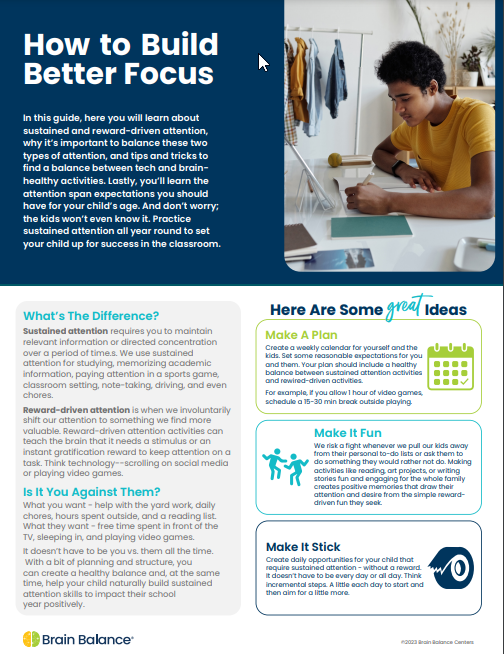
Build Better Focus Guide
In this guide, you will learn about sustained and reward-driven attention, why it’s important to balance these two types of attention, and tips and tricks to find a balance between tech and brain-healthy activities. Lastly, you’ll learn the attention span expectations you should have for your child’s age.
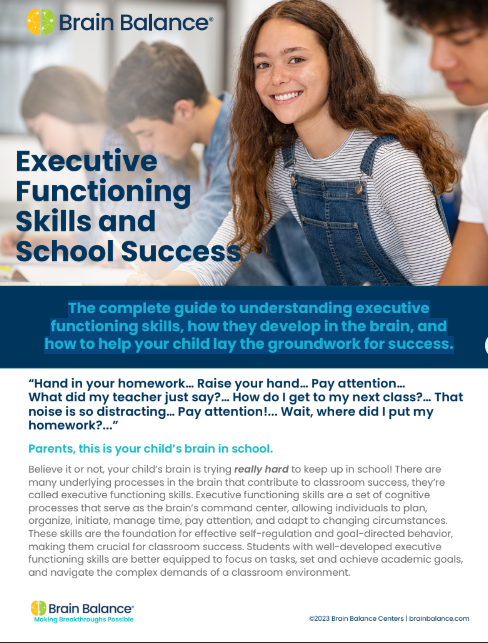
Executive Function Skills and School Success Guide
Executive functioning skills are the foundation for effective self-regulation and goal-directed behavior, making them crucial for classroom success. Students with well-developed executive functioning skills are better equipped to focus on tasks, set and achieve academic goals, and navigate the complex demands of a classroom environment. In this guide, you will gain an understanding of executive functioning skills, how they develop in the brain, and how to help your child lay the groundwork for success.
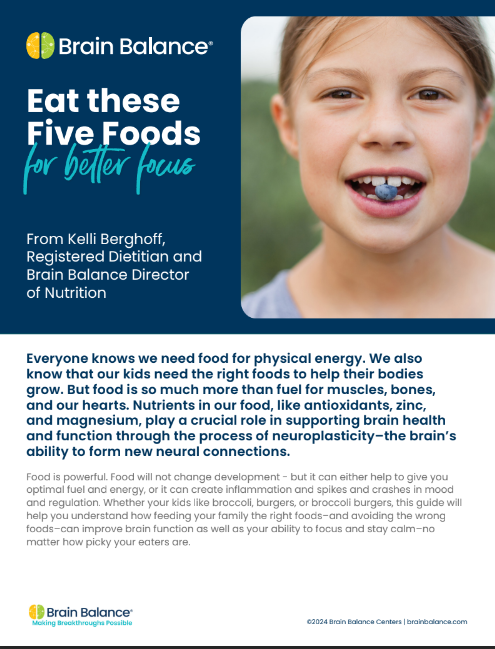
Eat These Five Foods for Better Focus
Download the free guide: "Eat These Five Foods for Better Focus" to learn how specific nutrient-dense foods can improve brain health, focus, and mood. This guide, written by Kelli Berghoff, Registered Dietitian, mom of two boys, and Brain Balance Director of Nutrition provides easy, family-friendly recipes and tips on incorporating these brain-boosting foods into daily meals while avoiding foods that cause inflammation and energy crashes.
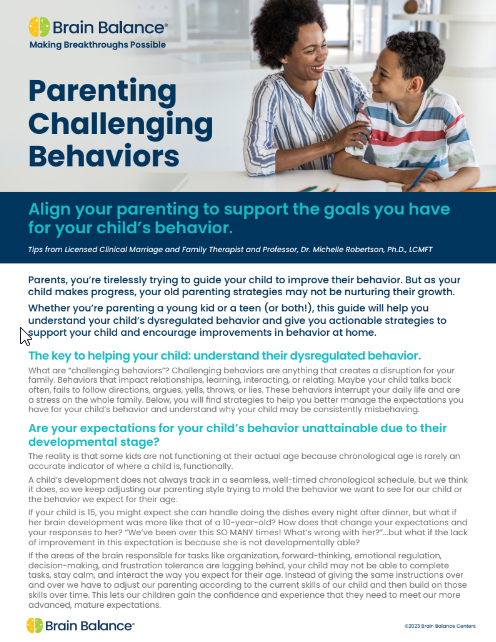
Parenting Challenging Behaviors
Tips from Licensed Clinical Marriage and Family Therapist and Professor, Dr. Michelle Robertson, Ph.D., LCMFT. Download the free guide to learn how to align your parenting to support the goals you have for your child’s behavior. Whether you’re parenting a young kid or a teen (or both!), this guide will help you understand your child’s dysregulated behavior and give you actionable strategies to support your child and encourage improvements in behavior at home.
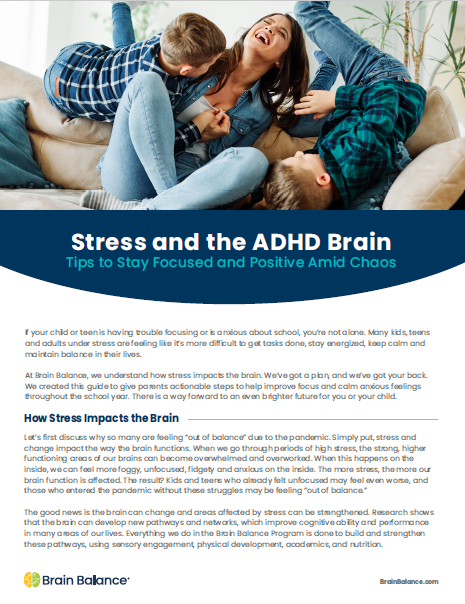
Stress and the ADHD Brain
This guide provides parents with actionable steps to help improve focus and calm anxious feelings both at home and at school. In the ADHD Guide, you'll learn about what happens in the brain of a child or teen with ADHD and how stress impacts their brain. You'll also discover strategies to help your child enhance their focus and manage anxious feelings. Additionally, the guide includes a daily optimal focus checklist to help keep kids focused and calm throughout the day.
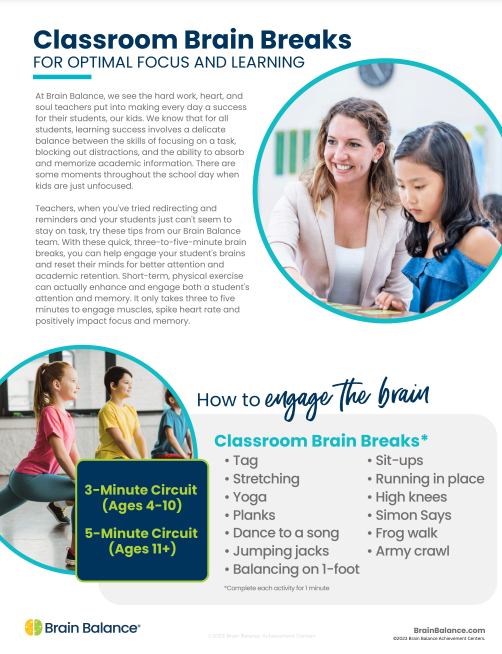
Classroom Brain Breaks for Better Focus
When teachers have tried redirecting and reminders and students just can't seem to stay on task, try these tips from our Brain Balance team. Download our free Classroom Brain Breaks resource for teachers. You'll get ideas to help keep students' brains engaged throughout the school day. With these quick, three-to-five-minute brain breaks, you can help engage students' brains and reset their minds for better attention and academic retention.
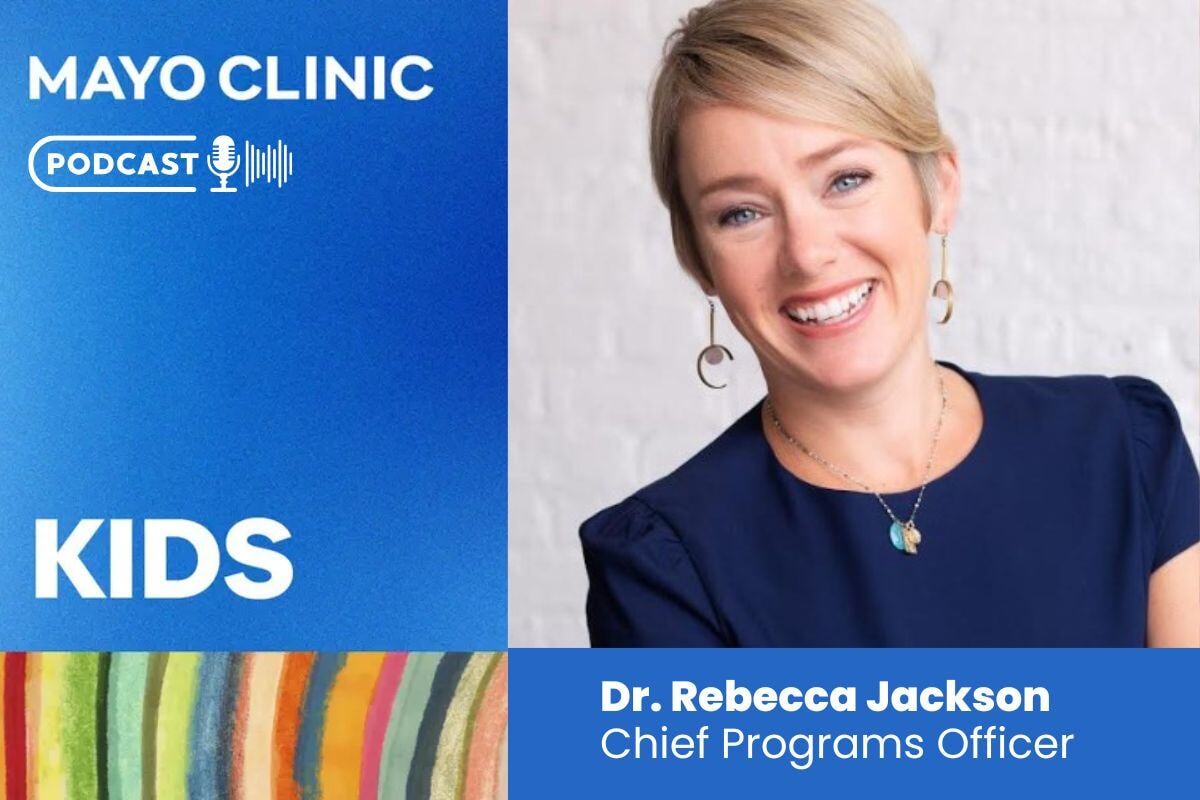
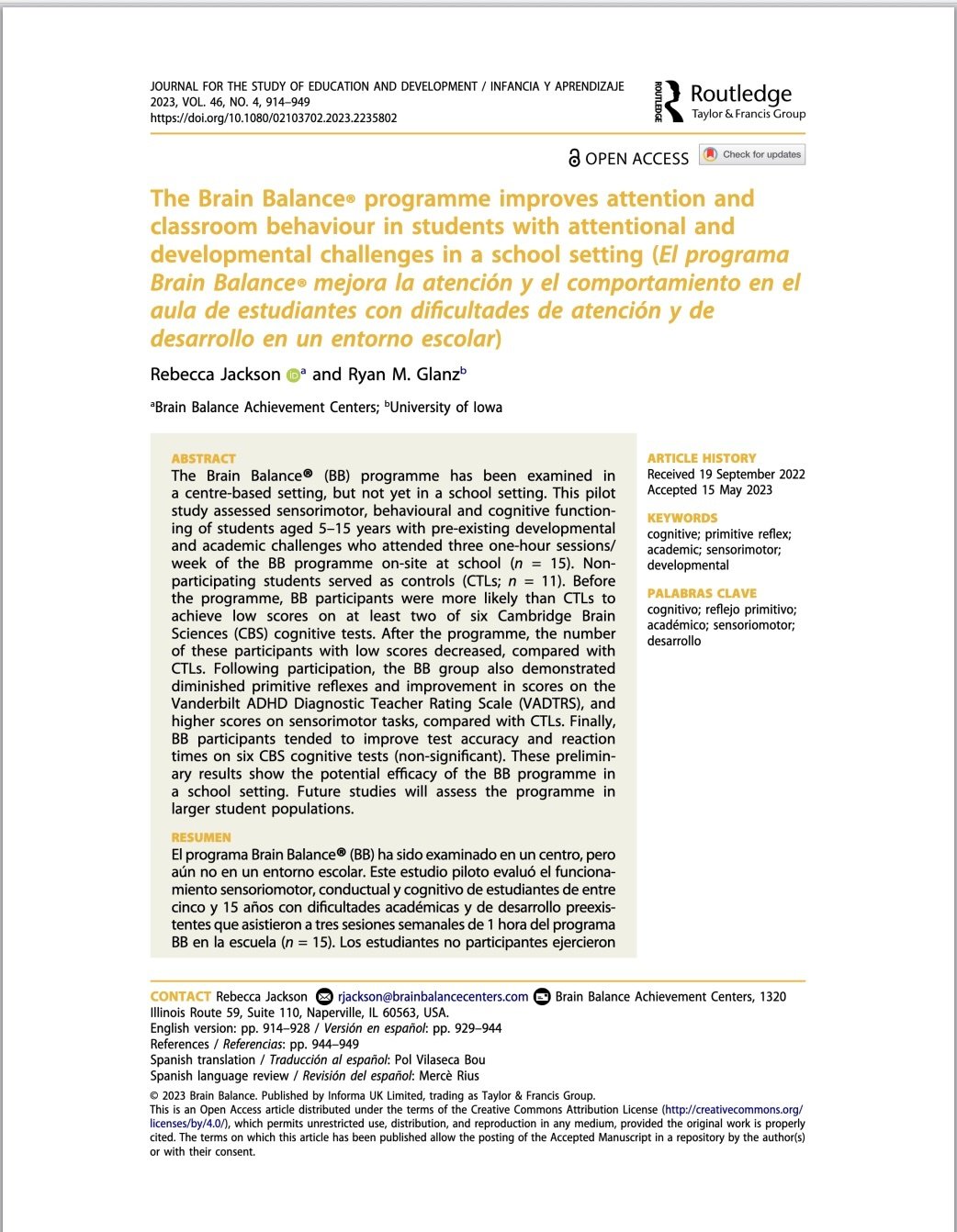

The Science Behind Focus & Distraction
Lack of focus impacts all areas of life, but solutions are complex. Join Dr. Rebecca Jackson and Dr. Joaquin Anguera as they discuss the latest science on focus, distraction, and three key insights for parents to help improve these challenges.

How to Help Your Child Build Better Focus
Join Dr. Courtney Gallen as she discusses two key attention abilities for academic success. Learn how mindfulness exercises can improve focus and discover practical tips parents can use now to help kids succeed in the next school year.

Get the Brain Ready for School Learning: Understanding Executive Functions
Parents, your child’s brain works hard to keep up in school! Executive functioning skills play a key role in success. Join Dr. Mark Goldenberg and Dr. Rebecca Jackson as they explore the importance of these skills and their impact on classroom performance.
%20(Video)%20(667%20%C3%97%20900%20px)%20(1080%20%C3%97%201080%20px)%20(1200%20%C3%97%20628%20px)-2.jpg)
ADHD: Beyond Medication
Join Dr. Rebecca Jackson as she discusses how a whole-child approach can reduce ADHD symptoms beyond medication. Hear from a Brain Balance parent who shares their family’s journey toward improved well-being.
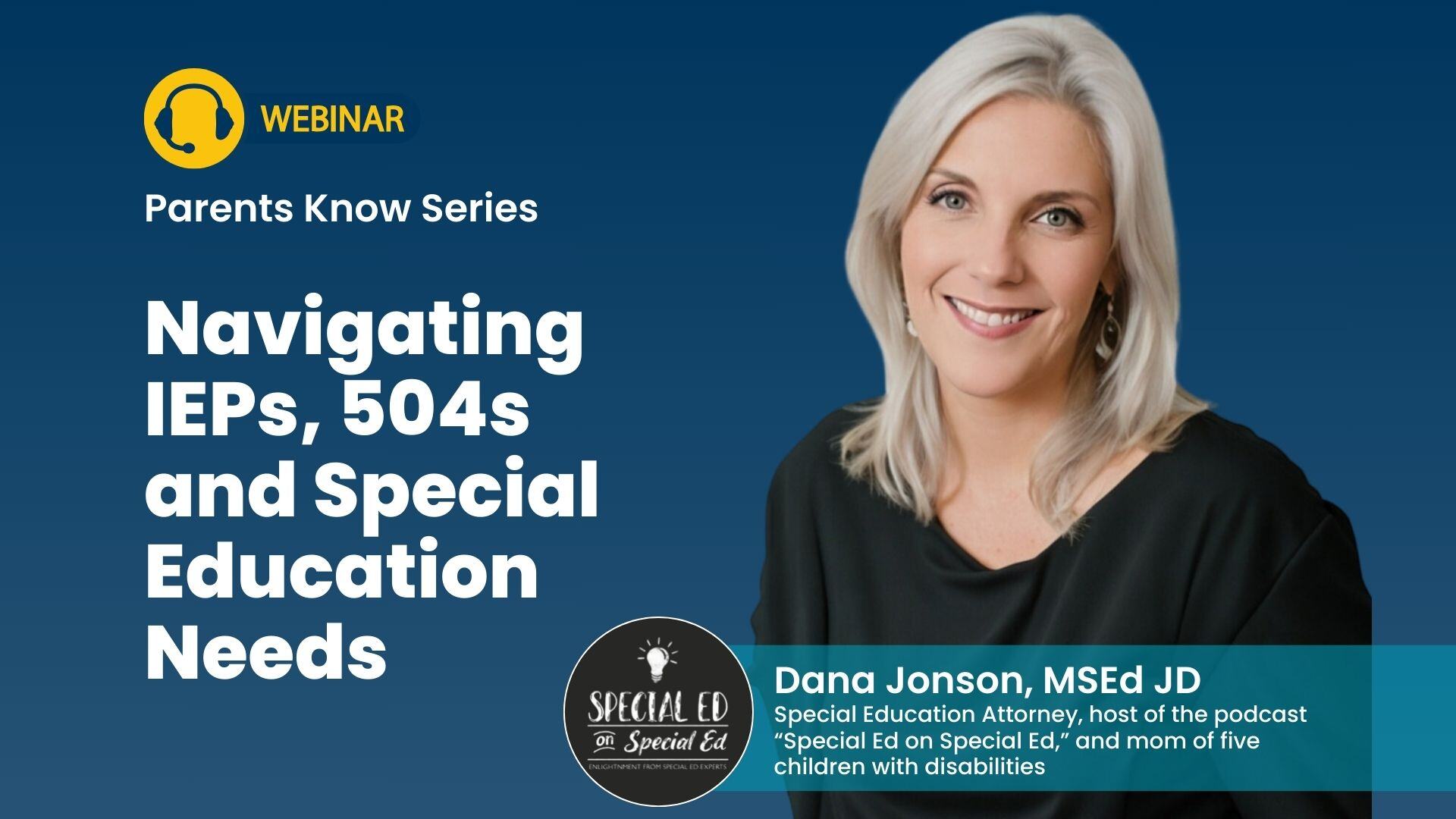
Navig
Special education attorney Dana Jonson joins to help parents navigate IEPs, 504 Plans, and when to bring in outside support. With 20+ years of experience—and five kids with disabilities of her own—Dana brings both legal expertise and real-world perspectives.

Parenting Challenging Behaviors
Join Dr. Rebecca Jackson and Dr. Michelle Robertson as they discuss how to align parenting strategies with your child's behavior goals. Learn effective approaches to support growth and address challenging behaviors in kids and teens.
%20march%202024%20kelli%20berghoff%20no%20logo-1.jpg)
Eat These Five Foods for Better Focus
Join Dr. Rebecca Jackson and Kelli Berghoff to explore the role of nutrition in managing ADHD. Learn about five foods to avoid and five that support focus, impulsivity, emotional regulation, and attention.
%20May%202024%20Robyn%20Silverman-2.jpg)
How to Help Kids Build Solid Friendships
Join Dr. Rebecca Jackson and Dr. Robyn Silverman as they discuss guiding children through the complexities of friendships. Dr. Silverman shares insights from her book, offering practical advice on teaching kids about friendship, identifying good friends, and navigating social dynamics.
.jpg)
Healthy Screen Habits for Kids and Teens: Understanding Impact and Taking Action
Join digital wellness expert Nicole Rawson to discuss the impact of screens on brain development, executive function, and physical activity. Learn how screens affect children with ADHD, sensory processing issues, and anxiety, and gain insights into managing screen time effectively.
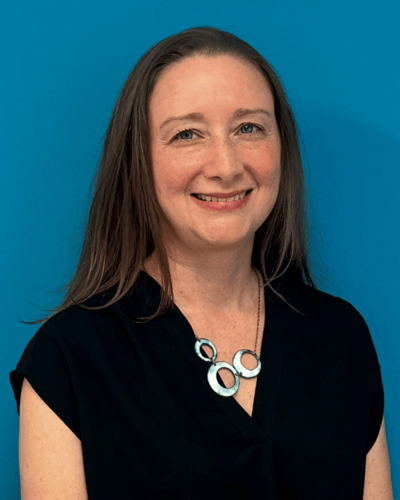 Sarah Weeks has spent over 20 years in education—not just observing from the sidelines, but deeply immersed in teaching, learning, leadership and advocacy. She started as a 1:1 aide working with students on the Autism Spectrum while still in college, then moved through classroom teaching, special education, and school leadership across New York City.
After Yale and master's degrees in Educational Policy and School Administration from Stanford and Pace, Sarah became the Founding Principal of a new public high school Brooklyn and led it for four years. She then scaled up to support 27 NYC secondary schools as Deputy Network Leader. Missing the daily work with students, teachers, and families, she returned to found a successful middle school program at an inclusive Brooklyn charter school.
Ready for a change of pace, and more time with her own young children, Sarah shifted to educational consulting and began a PhD at Teachers College, Columbia, focusing on inclusive leadership and equity-driven decision making. A one-year pause in her program to serve as an Interim Head of School reminded her where her heart really is: working directly with children, adolescents and parents, especially those who aren't thriving in conventional school settings.
After two decades championing families inside the system—fighting for the students traditional schools weren't built to serve—and years searching and fighting for services for her own children, Sarah knows too many children require something different from what’s typically available. She's been the advocate in IEP meetings, the principal pushing to meet the needs of all students, the leader helping teachers see students' potential instead of deficits, and the parent calling for attention to her child’s strengths and needs. She's seen too many brilliant kids struggle not because they can't learn, but because their schools weren’t ready to support how they learn. Opening Brain Balance of Brooklyn is her next act of advocacy: offering families an evidence-based, individualized approach that meets each person where they actually are. It's about giving parents and children, as well as adult learners, the tools and support they need to thrive.