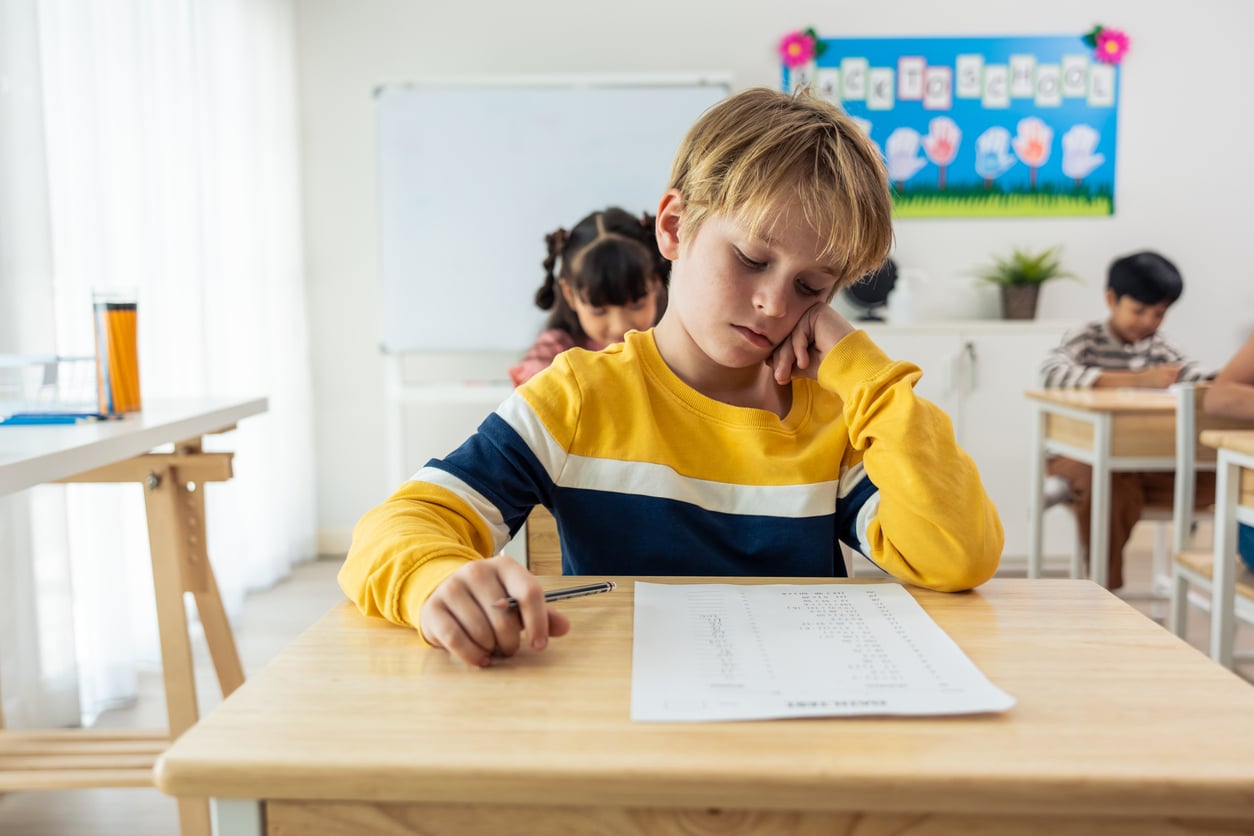
The school year has been underway for weeks. Your child knows the morning routine. Their teacher has explained what is expected. You've made the checklist, set the reminders, organized the backpack and talked through the same steps again and again.
And somehow, it's still not clicking.
A 2026 study published in Frontiers in Child and Adolescent Psychiatry helps explain why this experience is so common for families of children with ADHD. Researchers studied 205 children ages 6–12, including 104 children with ADHD, and found that children with ADHD had significantly more difficulty with morning routines and homework than their neurotypical peers. Parents also reported greater frustration around routines and a more stressful, less pleasant family climate when routines were difficult.
The study looked beyond whether children could simply follow a schedule. Researchers assessed behaviors related to working memory, planning and time management, behavioral self-regulation, and emotional self-regulation, all skills involved in successfully carrying out everyday routines.
And that's an important distinction for parents.
Your child may know exactly what they're supposed to do.
Maybe your child or teen struggles to get out the door every morning. Homework that should take 30 minutes stretches across the evening. Papers disappear into the backpack. They forget assignments they knew about that morning. They have trouble shifting from one task to another or staying focused long enough to finish.
For many families of children with ADHD, the transition back to school can make these challenges especially noticeable. And when the difficulties continue well beyond the first few weeks after summer break, parents may start wondering why routines that have been practiced repeatedly still aren't becoming automatic.
The answer may have less to do with whether your child knows the routine and more to do with the underlying brain functions required to consistently carry it out.
Quick Answer: Why Do Kids With ADHD Struggle With School Routines?
Children with ADHD can struggle with school routines because everyday tasks rely heavily on executive functions such as attention, working memory, planning, organization, task initiation, impulse control and cognitive flexibility.
A child may understand exactly what they're supposed to do but still have difficulty consistently putting all of those steps into action.
Visual schedules, reminders, checklists, predictable routines and school accommodations can be extremely helpful because they provide external structure. But when a child continues to struggle despite those supports, it may be worth looking more closely at the foundational cognitive and developmental skills that make independent routines possible.
Why Can a Simple School Routine Be So Hard for a Child With ADHD?
Think about what actually has to happen for a child to get ready for school.
They need to wake up, remember what comes next, get dressed, brush their teeth, eat breakfast, find their backpack, remember their homework, locate their shoes, keep track of time and get out the door.
That's not one task.
It's a series of tasks requiring the brain to remember, prioritize, organize, initiate, sustain attention, monitor time and transition repeatedly.
The same thing happens throughout the school day.
“Get ready for math” might require a child to stop what they're doing, shift their attention, remember the teacher's directions, put away one set of materials, find another, organize their workspace and begin a new task.
For a child whose executive-function skills are still developing, those seemingly simple routines can place significant demands on the brain.
What Executive-Function Skills Affect School Routines?
Several interconnected cognitive skills can contribute to ADHD school transition and routine difficulties.
Working Memory
Working memory allows us to hold information in mind long enough to use it.
A child might hear:
“Put your worksheet in your folder, grab your planner, write down tonight's assignment and put everything in your backpack.”
They may genuinely intend to do all four things and lose track after step two.
Attention and Focus
School requires children to repeatedly direct and sustain attention, often on activities that aren't particularly interesting.
A child may start getting dressed and notice a toy. Start packing their backpack and remember something else. Begin homework and become distracted by what's happening around them.
The issue isn't necessarily understanding what needs to happen. It's staying engaged with the task long enough to complete it.
Planning and Organization
Keeping track of folders, assignments, due dates, sports equipment, lunches and school supplies requires planning and organization.
When these skills are difficult, parents can feel like they are constantly functioning as their child's external organizational system.
Task Initiation
Sometimes the hardest part isn't completing the task. It's starting it.
A child may know homework needs to happen but sit at the table unable to begin without repeated prompting.
Cognitive Flexibility
A school day is filled with transitions.
Wake up. Get dressed. Leave home. Enter school. Change subjects. Stop a preferred activity. Start a difficult one. Move classrooms. Come home. Start homework.
Cognitive flexibility helps the brain disengage from one activity and shift efficiently to another. When shifting is difficult, transitions can trigger resistance, frustration or emotional overwhelm.
Why Doesn't Repeating the Routine Always Make It Automatic?
This is where parents often become frustrated.
We've practiced this 100 times. Why do I still have to tell you what to do?
Repeated practice is important. Predictability can reduce cognitive demands and give children more opportunities to develop habits.
But repetition still relies on the brain systems responsible for learning and carrying out that routine.
If attention, working memory, planning or self-regulation are difficult for a child, simply providing the same instruction more often may not address the skills making the routine difficult in the first place.
This is why a child can know what to do without being able to consistently do it independently.
That distinction matters.
What If We've Already Tried Charts, Reminders and Structured Routines?
Keep using the strategies that help.
Visual schedules, checklists, timers, consistent places for school materials, transition warnings, teacher reminders and breaking large tasks into smaller steps can all reduce demands on executive function.
For some children, these supports are exactly what they need.
But other parents reach a point where they realize:
We're providing a tremendous amount of external support, and my child still can't consistently manage these routines independently.
That can be a reason to look beyond the routine itself.
Instead of only asking:
“How can I make the checklist better?”
It may be helpful to ask:
“What skills does my child need in order to use this checklist successfully?”
Why Does the Transition Back to School Make ADHD Challenges More Noticeable?
Summer and the school year place very different demands on the brain.
Even when children have summer routines, they often have more flexibility, fewer academic demands and fewer rapid transitions than they encounter during school.
Returning to school suddenly requires children to manage:
- Earlier mornings
- Longer periods of sustained attention
- More transitions
- Multiple teachers or classrooms
- Homework and deadlines
- Increased organization
- More complex instructions
- Social demands
- Less downtime
- Greater independence
Some adjustment at the beginning of the school year is expected.
But if you're well into the semester and thinking, “This year seems particularly hard for my child,” it may be worth paying attention to what isn't improving with time.
Are mornings still chaotic?
Is homework consistently overwhelming?
Is your child forgetting materials or assignments?
Are you providing constant reminders?
Are transitions leading to frustration?
Does your teen understand exactly what needs to happen but still struggle to organize and follow through?
Those patterns can provide clues about the underlying skills that need additional support.
Is It Defiance, or Is My Child Having Trouble With the Skills the Routine Requires?
Behavior doesn't always tell us why a child is struggling.
A child who refuses to start homework may be overwhelmed by the number of steps involved.
A child who repeatedly forgets their folder may have difficulty with working memory and organization.
A child who becomes upset when it's time to leave may struggle with shifting attention and emotional regulation.
A teenager who waits until 10 p.m. to begin an assignment may understand the deadline perfectly but struggle with planning, task initiation and time management.
That doesn't mean expectations should disappear.
It means understanding why the expectation is difficult can help parents choose more useful support.
What Does Brain Connectivity Have to Do With ADHD and School Routines?
Skills such as attention, working memory, planning and self-regulation don't happen in isolation. They depend on coordinated activity across networks of the brain.
Research increasingly examines ADHD and other learning and attention challenges through the lens of brain networks and connectivity, rather than assuming that one isolated brain region controls a complex behavior.
This matters when we think about everyday school functioning.
Getting through a morning routine, transitioning between activities or completing homework requires multiple sensory, motor and cognitive systems to work together efficiently.
So when a child continues to struggle despite knowing what is expected, families may benefit from looking beyond the individual behavior and considering the underlying skills and systems involved in performing it.
How Can Brain Balance Help With ADHD School Routine Difficulties?
Brain Balance is a non-medical, drug-free program designed to strengthen the underlying functions that support attention, behavior, learning and executive functioning.
Rather than practicing a specific morning routine or teaching a child how to complete a particular homework assignment, the program uses an integrated combination of sensory-motor exercises, physical activity and cognitive activities designed around each participant's areas of strength and challenge.
For children struggling with school routines, relevant areas can include:
- Attention and concentration
- Working memory
- Planning
- Executive function
- Response inhibition
- Processing
- Reasoning
- Sensory-motor skills
- Coordination and body awareness
The distinction is important:
A routine tells a child what to do. Brain Balance focuses on strengthening foundational functions involved in consistently carrying it out.
Brain Balance can complement the strategies and supports families may already be using, including school accommodations, behavioral strategies, tutoring, therapy or medical care. It is not intended to replace appropriate medical, educational or therapeutic support. Brain Balance Research Source I…
What Does Research Say About Brain Balance and Cognitive Skills Related to School Success?
A study conducted in collaboration with Cambridge Brain Sciences examined cognitive performance among children and adolescents with developmental and attentional challenges participating in Brain Balance.
The study included 478 participants ages 4–18. Participants ages seven and older who completed three months of the program demonstrated significant improvement across all 12 cognitive tasks measured, with the largest improvements in memory, reasoning, verbal ability and concentration. The assessments also measured areas relevant to school routines, including attention, working memory, planning and executive function. Pasted markdown(2)
Importantly, participants did not practice the Cambridge Brain Sciences tasks as part of Brain Balance, so the observed improvements represented transfer to cognitive tasks that were not directly trained. The study was not randomized, its comparison group had some Brain Balance exposure, and it did not include long-term follow-up, so the findings should not be interpreted as proof that the program will produce the same results for every child. Pasted markdown(2)
Other Brain Balance research has reported changes in areas including attention, working memory, response inhibition, reasoning, processing speed and executive functioning, as well as teacher-rated attention and classroom behavior. Pasted text(33)
What Results Have Parents Reported Around School and Academic Engagement?
Brain Balance also tracks parent-reported outcomes.
Between 2022 and 2025, more than 2,500 families completed Brain Balance's Multi-Domain Developmental Survey. Among participants who entered the program with concerns in those areas, 80.3% showed parent-reported improvement in academic engagement and 80.3% in reading/writing. Across all six measured developmental domains, 89% demonstrated meaningful improvement in at least one area of concern. Pasted markdown(2)
These are parent-reported outcomes rather than results from a randomized clinical trial, and individual results vary.
What Should Parents Do When School Routines Still Aren't Clicking?
Start by identifying where the routine breaks down.
Is your child struggling to:
- Get started without repeated prompting?
- Remember multiple steps?
- Stay focused until a task is finished?
- Keep track of belongings?
- Estimate and manage time?
- Shift from one activity to another?
- Organize homework and assignments?
- Regulate frustration when something feels difficult?
That information can help you move beyond “They need to try harder” toward understanding which skills may need more support.
Continue using the routines, visual supports, accommodations and professional resources that help your child. But if you're constantly providing reminders, creating new charts and repeating expectations without seeing greater independence, it may be worth evaluating the foundational cognitive and sensory-motor functions involved.
Sometimes the next step isn't another reminder. It's understanding why your child still needs the reminder.
Parents Also Ask
Do children with ADHD need more repetition to learn routines?
They may. Consistent repetition and predictable structure can reduce demands on working memory and executive function. However, some children continue to require significant prompting even after a routine has been practiced repeatedly. In those cases, it can be useful to look at the specific skills interfering with independent follow-through.
Why does my child with ADHD know the routine but still not follow it?
Knowing a routine and independently executing it require different skills. Working memory, attention, planning, organization, task initiation and cognitive flexibility can all affect whether a child is able to translate what they know into consistent action.
Why are transitions so hard for kids with ADHD?
Transitions require children to stop one activity, shift attention, process what comes next and initiate a new task. Difficulties with attention, cognitive flexibility, executive function or emotional regulation can make that process more challenging.
Why is my child with ADHD struggling more this school year?
Increased academic demands, more complex schedules, greater expectations for independence and changes in teachers or routines can expose skills that weren't as noticeable previously. If struggles persist beyond the normal back-to-school adjustment period, consider discussing the pattern with your child's teacher and appropriate healthcare or educational professionals.
Can Brain Balance help with executive function and attention?
Brain Balance is designed to strengthen underlying sensory-motor and cognitive functions associated with attention, learning, behavior and executive functioning. Published Brain Balance research has reported pre-to-post improvements across cognitive measures including attention, working memory, planning, concentration and executive function, although individual outcomes vary and the existing research has important limitations. Pasted markdown(2)
The Bottom Line
If your child is still struggling to get ready for school, stay organized, transition between activities, keep up with homework or stay focused, even after you've established routines and provided plenty of reminders, the problem may not be that they don't understand what's expected.
The skills required to independently carry out those expectations may still need support.
Understanding the connection between attention, working memory, executive function and daily routines can help parents move beyond repeating instructions and toward identifying the areas that are making everyday school demands so difficult.
If school routines still aren't clicking for your child or teen, find a Brain Balance Center near you to learn more about our personalized assessment and program.