



Brain Balance Program Results & Research
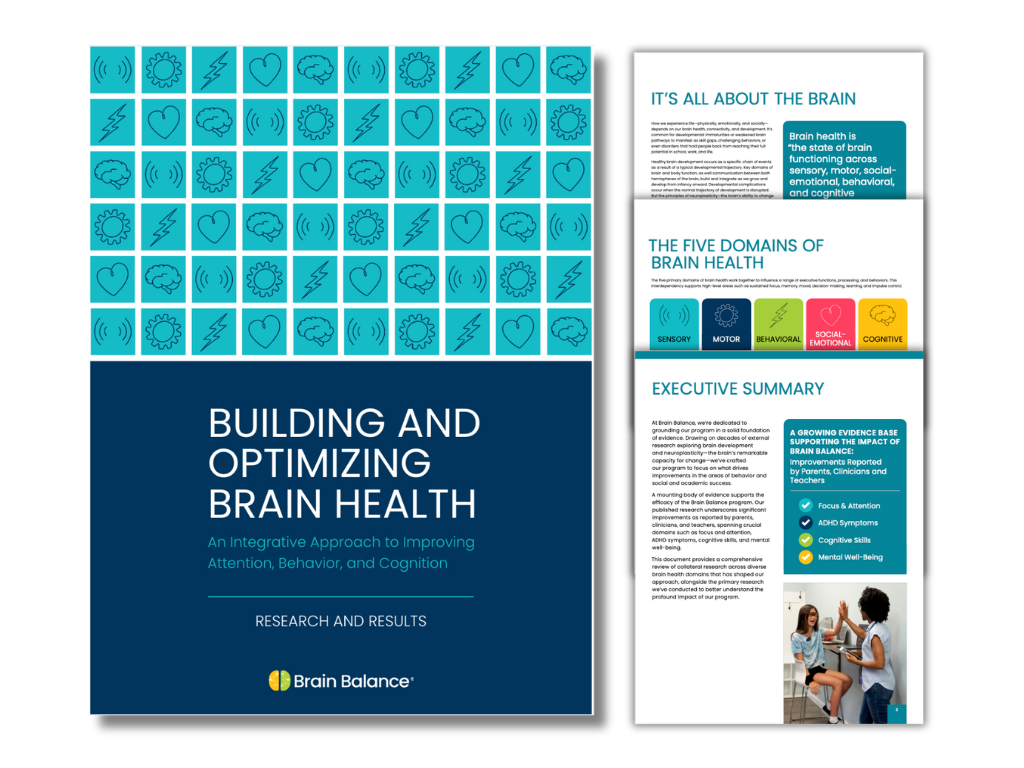
A GROWING EVIDENCE BASE SUPPORTING THE IMPACT OF BRAIN BALANCE:
Improvements Reported by Parents, Clinicians and Teachers
At Brain Balance, we’re dedicated to grounding our program in a solid foundation of evidence. Drawing on decades of external research exploring brain development and neuroplasticity—the brain’s remarkable capacity for change—we’ve crafted our program to focus on what drives improvements in the areas of behavior, social and academic success.
A mounting body of evidence supports the efficacy of the Brain Balance Program®. Our published research underscores significant improvements as reported by parents, clinicians, and teachers, spanning crucial domains such as focus and attention, ADHD symptoms, cognitive skills, and mental well-being.
 Focus & Attention
 ADHD Symptoms
 Cognitive Skills
 Mental Well-Being
Review the Research
This document provides a comprehensive review of collateral research across diverse brain health domains that has shaped our approach, alongside the primary research we’ve conducted to better understand the profound impact of our program.
Brain Balance Peer-Reviewed Research Studies
Our peer-reviewed, published research demonstrates that our program leads to consistent and significant outcomes in the areas of decreased hyperactivity, impulsivity, and negative behaviors; and improved attention, cognition, social- emotional functioning, and motor development.

Reliable change in parent-rated scores on the Brown Attention-Deficit Disorder Scales® from pre- to post-participation in the Brain Balance program
Key Findings:
- Parents reported a decrease in ADHD symptoms.
- A majority of participants (81%) demonstrated improvement in the Brown Scale score as reported by their parents pre and post-program (3-month program).
- Kids with more severe ADHD symptoms are more likely to observe a decrease in symptoms.

Open assessment of the therapeutic and rate-dependent effects of brain balance center® and interactive metronome® exercises on children with attention deficit hyperactivity disorder
A Harvard Medical School /McLean Hospital study found the Brain Balance Program to be as effective as low-dose medication in alleviating ADHD symptoms in kids.
- Marked reduction in ADHD symptoms were reported by parents and clinicians and seen on diagnostic testing
- Areas impacted included hyperactivity, inattention, and improved accuracy on cognitive tests
Read the Summary | Go to the Publication

Effect of the Brain Balance Program® on Cognitive Performance in Children and Adolescents with Developmental and Attentional Issues
In a study conducted in collaboration with Cambridge Brain Sciences, showed that children saw significant overall improvements after 3 months across all cognitive tasks measured, with the greatest changes seen on tasks of memory, reasoning, verbal ability and concentration.

A Retrospective Review of Parent-Reported Anxiety and Emotional Functioning in Children with Developmental Challenges After Participation in the Brain Balance® Program
Key Findings:
After completion of a 5-6 month program, parents reported significant improvements in feelings of happiness, academic follow-through and motivation, school performance and test scores, social confidence and feelings of anxiety.

The Brain Balance® programme improves attention and classroom behaviour in students with attentional and developmental challenges in a school setting
Key Findings:
Brain Balance program helps improve childhood developmental outcomes, especially for more impaired participants who have the most to gain with respect to improvement in emotional, social, behavioral, motor, and academic functioning.

Reliable change in developmental outcomes of Brain Balance® participants stratified by baseline severity
Results demonstrate improvements in primitive reflex integration and sensory motor skills, as well as statistically significant reliable change in emotionality, reading/writing, behavior, academic engagement, motor skills, and social communication in Brain Balance participants from pre- to post-program.

Cognitive outcomes of the at-home brain balance program
Results demonstrate the Brain Balance® at-home program improves attention, response inhibition, working memory, and reasoning in children and adolescents. Results for the at-home program are comparable to the in-center program, offering a flexible, accessible solution for developmental and attentional challenges.
Brain Balance Research Study White Papers
Our white papers demonstrate that the Brain Balance program leads to significant improvements in foundational sensory-motor development and primitive reflex integration, alongside parent-reported gains in attention, behavior, emotional regulation, academic engagement, and social communication in children and adolescents with Autism Spectrum Disorder (ASD).
Developmental Outcomes of the Brain Balance® Program in Autism Spectrum Disorder (ASD): A Control Group Study
This controlled study examined whether a comprehensive sensory motor program could improve foundational development in children and adolescents with autism spectrum disorder (ASD), compared to a non-intervention control group.
Key Findings:
-
Significant improvements in 5 of 6 sensory motor domains (coordination, balance, gaze stability, rhythm & timing, fine motor skills) compared to controls (p < .001)
-
Primitive reflex maturation observed across multiple reflexes, including Moro, ATNR, and Landau
-
No meaningful changes were observed in the control group
Sensory Motor Intervention and Multi-Domain Developmental Outcomes in Autism Spectrum Disorder: A Large Observational Study
This large-scale study evaluated outcomes for 875 children and adolescents with ASD who completed the Brain Balance program, measuring changes in sensory motor function, primitive reflexes, and real-world developmental outcomes.
Key Findings:
-
Large effect sizes across all sensory motor domains (d = 1.00–1.51)
-
All 8 primitive reflexes improved, with 6 showing large effect sizes
-
73.6% of parents reported improvement in social communication
-
74.6% reported overall developmental improvement across behavior, academics, and emotional functioning
-
Children with greater initial challenges experienced the largest gains
Learn More About the Science Behind the Brain Balance Program